






Organizations evaluating content systems often come across two terms that look and sound similar, but serve different purposes: LCMS and CCMS. Both systems support modular content, both strengthen consistency, and both help teams deliver information at scale. Despite these similarities, they are designed for different audiences and solve different operational challenges.
This article explains what an LCMS is, what a CCMS is, why the terminology often overlaps, and how each system fits into learning and documentation workflows. The goal is to clarify the differences without positioning the systems against each other. Each one provides value, and many organizations rely on both.
What Is an LCMS?
A Learning Content Management System (LCMS) is a platform for creating, managing, and delivering learning content. It supports the full lifecycle of instructional materials, from ideation and development through delivery and performance tracking.
An LCMS helps learning and development teams build reusable learning objects such as modules, quizzes, simulations, videos, and assessments. It also helps organize content into structured courses and publish those courses to an LMS for delivery.
LCMS platforms are designed around instructional design principles. They help teams collaborate, maintain consistency across large training programs, reuse materials, and personalize learner experiences.
Common LCMS capabilities include:
- Creating and managing learning modules and reusable content blocks
- Organizing content into courses or personalized learning paths
- Publishing learning materials to an LMS
- Tracking learner performance and engagement
- Supporting adaptive or personalized instruction
- Providing templates to standardize course design
An LCMS becomes especially valuable for organizations with significant training requirements. It helps maintain consistency across global teams, reduces duplication, and measures the effectiveness of learning materials over time.
What Is a CCMS?
A Component Content Management System (CCMS) is a platform designed to manage content at the component level. Instead of storing information as full documents, a CCMS breaks content into modular units such as topics, snippets, variables, and metadata.
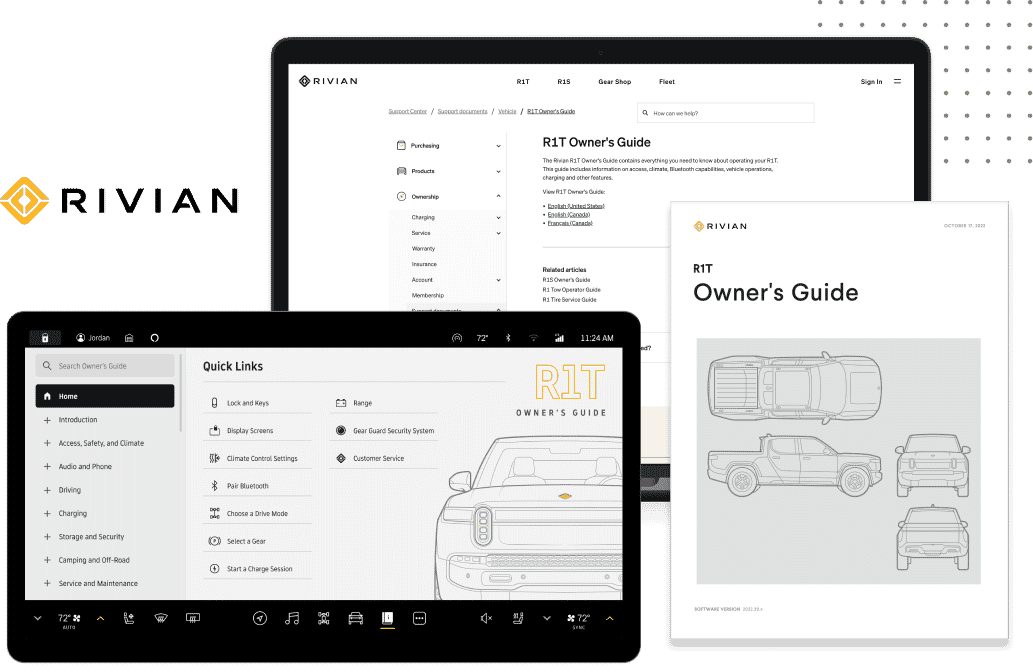
Technical writers and documentation teams use a CCMS to maintain consistency across large volumes of product or technical content. A CCMS supports structured authoring, content reuse, controlled terminology, translation workflows, and multichannel publishing.
A CCMS also provides the version control and governance structure needed to maintain content accuracy as products evolve. These capabilities are especially important for teams managing complex documents, regulatory requirements, or multilingual content sets.
In environments where teams rely on a component-based content structure, a CCMS helps maintain accuracy and alignment across all outputs that use those components.
Common CCMS capabilities include:
- Managing content as reusable components
- Supporting structured authoring standards
- Publishing to HTML, PDF, portals, and in-product help
- Maintaining version control, branching, and workflow approvals
- Improving translation efficiency through component-level reuse
- Managing metadata and taxonomy for large content libraries
A CCMS is well-suited for organizations that update content frequently or support multiple product lines. It simplifies maintenance, reduces manual editing, and ensures consistency across formats.
Where the Confusion Comes From
LCMS and CCMS platforms share some familiar terminology. Both work with modular content, and both support collaboration. Because of this overlap, the two systems are sometimes misinterpreted as similar tools.
The confusion usually stems from phrases like modules, reuse, content components, and learning objects. While these words appear in both environments, they refer to different types of content and different goals.
An LCMS manages learning materials and training experiences. A CCMS manages structured documentation and product content. Both rely on modularity, but their objectives are distinct.
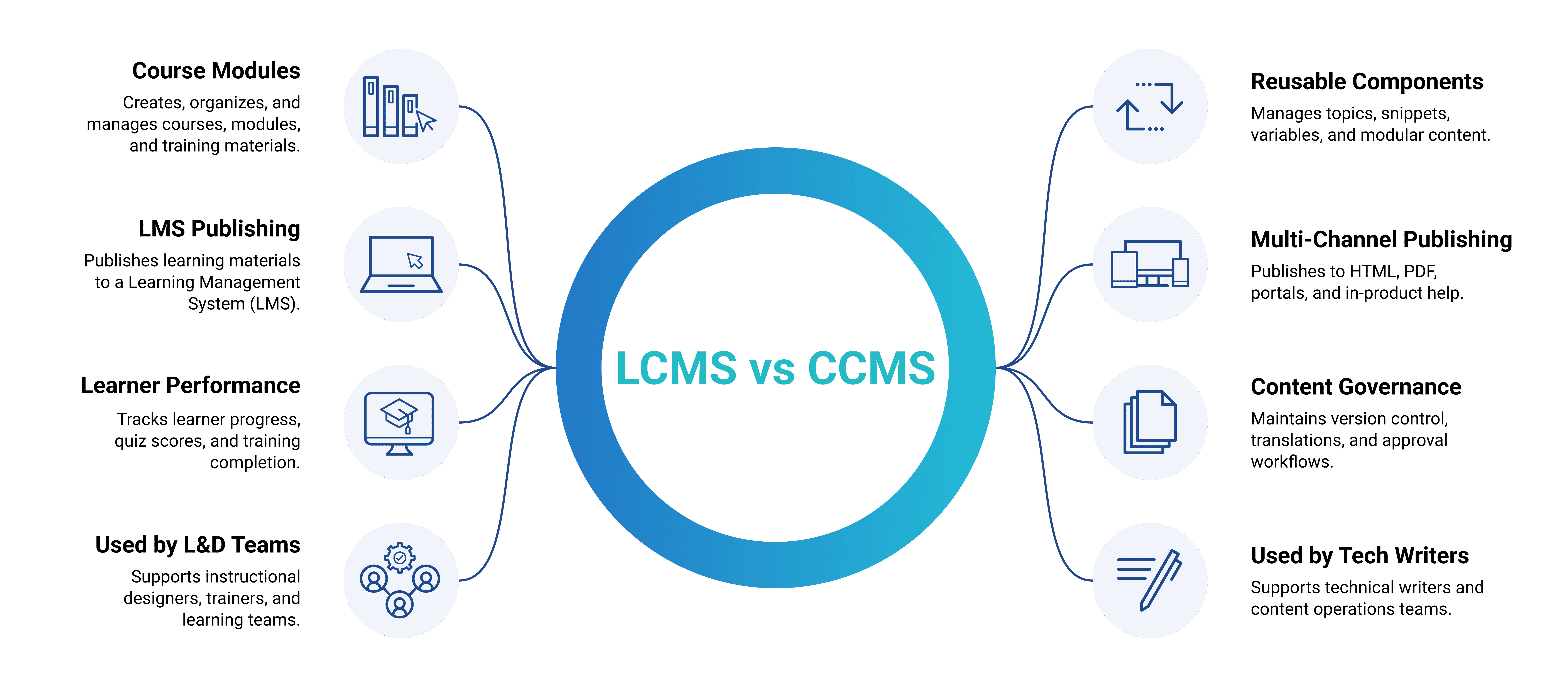
Looking at the two systems side by side makes the distinctions easier to see.
Compatibility / Focus Area | LCMS | CCMS |
|---|---|---|
Learning content creation | Primary focus | -- |
Structured documentation creation | -- | Primary focus |
Courses, modules, and assessments |

| -- |
Topics, snippets, reusable components | -- |
|
Publishing destination | LMS | HTML, PDF, portals, in-product help |
Learner performance tracking |
| -- |
Translation, versioning, governance | -- |
|
Primary users | Learning & development teams | Technical writers & content ops teams |
Recognizing these distinctions helps organizations select the right system for their needs.
Advantages of an LCMS
An LCMS is built for organizations that deliver training programs. Its strengths align with instructional design, learner engagement, and performance measurement.
Key advantages include:
- Centralized creation and management of learning content
- Easier reuse of learning objects across courses
- Better control of assessments and quizzes
- Personalization of learning paths based on audience or role
- Seamless publishing to LMS environments
- Analytics that track learner progress and identify skill gaps
LCMS platforms help learning and development teams scale their efforts. They reduce duplication, maintain consistent standards across training materials, and provide insights that guide future instruction.
Teams that need to update training content frequently or serve multiple learner groups benefit the most from an LCMS. The structured environment ensures materials remain accurate and aligned across programs.
Advantages of a CCMS
A CCMS is built for teams that manage large documentation collections. It supports structured authoring, which allows teams to reuse content across outputs, maintain accuracy, and publish consistent information everywhere it appears.
Key advantages include:
- Reuse of components across product lines and documentation types
- Strong consistency in language, structure, and terminology
- Single-source publishing to many output formats
- Version control with clear histories and approval workflows
- Better translation efficiency through component reuse
- Less manual work when products change or documentation grows
A CCMS simplifies the management of technical content at scale. When documentation covers multiple products, versions, or audiences, a CCMS ensures updates are applied consistently and efficiently.
Documentation teams often rely on structured authoring models. A CCMS helps enforce those structures while giving reviewers and editors a clear way to track changes and maintain quality.
When Organizations Use Both
Many organizations use both an LCMS and a CCMS. Each platform supports different teams and different kinds of content work.
In a combined model:
- An LCMS supports instructional designers, trainers, and learning teams
- A CCMS supports technical writers, content strategists, and documentation teams
- Each system manages its own content type and delivery model
- Some learning materials may draw from source content kept in a CCMS
- Some documentation may reference training content managed in an LCMS
This approach allows learning teams to deliver effective training while documentation teams maintain accurate, structured product information.
The systems complement each other. The LCMS focuses on the learner journey, while the CCMS focuses on structured content governance.
Bringing the Concepts Together
An LCMS and a CCMS serve different, but closely related, content needs. An LCMS supports the creation of learning content, course development, and performance tracking. A CCMS supports structured authoring, component reuse, and multichannel publishing.
Understanding these differences helps organizations choose the right tool for their teams and workflows. In many environments, both systems are used together because they support different stages of the content lifecycle.
Clear definitions reduce confusion and give teams the clarity they need when evaluating content technology.
Frequently Asked Questions
What is an LCMS?
An LCMS is a learning content management system used to create, organize, and deliver training content, including courses, modules, and assessments.
What is a CCMS?
A CCMS is a component content management system used to create, manage, and publish structured documentation across multiple formats.
Why are LCMS and CCMS often confused?
Both systems use modular content and support collaborative development, but they serve different purposes. An LCMS supports learning and training, while a CCMS supports documentation and product content.
Can an organization use both?
Yes. Many organizations use both systems. Each one supports a different part of the content lifecycle and serves different teams.