






In the next five years, 40% of core skills will change and 50% of the global workforce will need reskilling and upskilling, highlighting the potential ROI of training, reskilling and upskilling programs.
In the U.S., 82% of employees and 62% of HR directors said they believe that workers will need to reskill at least once a year to maintain a competitive advantage in a global job market.
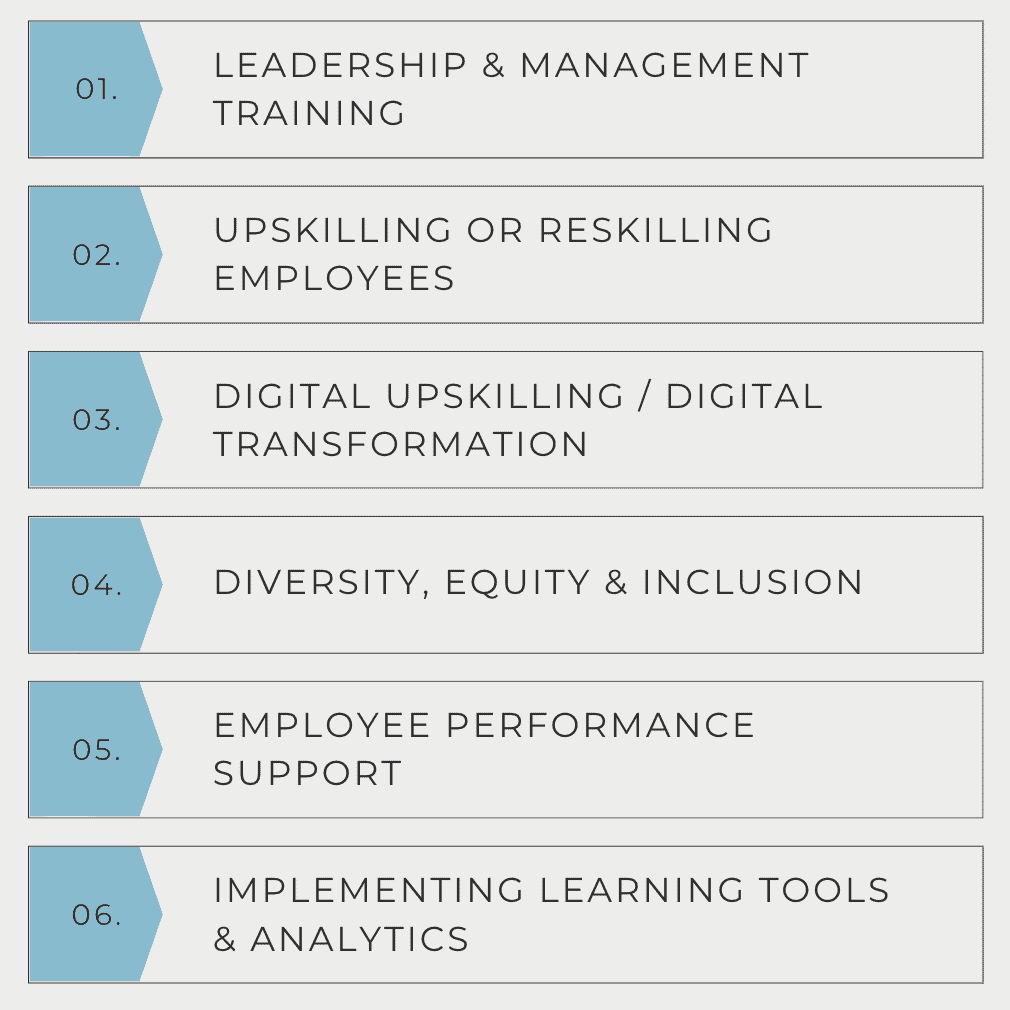
It’s no surprise that 46% of Learning and Development leaders surveyed in LinkedIn Learning’s 2022 Workplace Learning Report said Reskilling and Upskilling were a top focus area this year, second only to Leadership and Management Training and followed closely by Digital Upskilling / Digital Transformation.
Diversity, Equity & Inclusion ranked fourth, while Employee Performance Support and Implementing Learning Tools and Analytics ranked fifth and sixth, respectively.
“One great way to keep people engaged and motivated is through solid training and development programs,” says Rich Henson of HRMorning.
Sixty percent of CEO’s surveyed in PWC’s 2020 Global CEO Survey said that a strong upskilling program positively impacts company culture — the same 60% of CEOs also said they had more confidence in their revenue, underscoring the potential ROI of training, reskilling and upskilling.
Additionally, 93% of Millennial and Gen Z workers surveyed said they expect employers to provide learning opportunities.
The ROI of training, reskilling and upskilling is driven by:
- Improving engagement and reducing voluntary turnover by increasing opportunities for personal & career growth
- Improving day-to-day outcomes with necessary skills
- Reducing errors, accidents and non-compliance incidents through proper education
- Driving a more positive employee experience by setting your teams up for success
But effective training content can’t be one-size-fits-all. There are simply too many needs, use cases, experience levels, and delivery channels at play for it to work.
To really move the needle on outcomes, training content has to be personalized — but that’s easier said than done.
“Old models cannot deliver this sort of personalized learning experience at scale — the frameworks, content formats and modalities companies use are not designed to do this,” according to Brandon Hall Group.
Watch our recent webinar with The Learning Guild, “The Secret to Driving Engagement with Personalized Content,” for a closer look at:
The Secret to Driving Engagement with Personalized Content
With just 36% of U.S. workers actively engaged in the workplace as of the first half of 2022, delivering personalized content and learning experiences at scale is becoming increasingly critical.
The key to driving engagement with personalized content is making it easy for your employees to access the information, training, reskilling/upskilling content, and on-the-job resources they need at the point of need — that is, providing the content they need, exactly when and where they need it.
In other words, providing truly personalized content experiences.
Most organizations, however, are frustrated that their investments in technology (LMS, LXP, DAP) have failed to deliver the personalized content and user experiences they had hoped for. Organizations that are able to unlock the secret to personalization at scale and succeed in driving engagement with personalized content will have a distinct competitive advantage in the marketplace.
“Old models cannot deliver this sort of personalized learning experience at scale — the frameworks, content formats and modalities companies use are not designed to do this,” according to Brandon Hall Group.
Watch the webinar, hosted by The Learning Guild, to discover:
- Why you need to move from omnichannel to multi-experience content
- How standardization is critical to effective personalization at scale
- Real-world strategies for success and why content matters