





Customer Success Story
Bullhorn Reduces Support Demands by Using the MadCap Flare to Provide Customers with a Central Cloud-Based Hub for Knowledge Base Content
 Share
Share
 Share
Share
 Tweet
Tweet



The Big Win
Today, 10,000-plus staffing and recruitment companies around the globe, ranging from startups to the world’s largest enterprises, rely on Bullhorn. To facilitate customer self-service and reduce demands on its support team, Bullhorn relies on MadCap Flare.
Reduced Support Demands: AI-powered chat, unified search, and knowledge base documentation have helped users get the information they need faster, reduced support tickets, and shortened support calls at Bullhorn.
Streamlined Content Delivery: Using MadCap Flare for topic-based authoring, multi-channel publishing, conditional output, global project linking, and templates speeds the delivery and maintenance of 10,000 documentation pages covering 20 products.
Easier Collaboration: Cloud-based collaboration with MadCap Flare Online has reduced the average time to incorporate SMEs’ edits from 3 hours to 30 minutes or less.
For more than 25 years, Bullhorn has provided industry-leading, cloud-based software to power the recruitment lifecycle, from digitizing the recruitment process to reimagining it entirely through the infusion of artificial intelligence (AI). Over 10,000 staffing and recruitment companies around the globe, ranging from startups to the world’s largest enterprises, now rely on Bullhorn to streamline their efforts, so they can focus on putting people to work.
To help staffing professionals make the most of its cloud software, Bullhorn maintains multiple documentation sites—all linked to Bullhorn Hub—so customers can easily access the information they need from a central location. Today, Bullhorn uses both the cloud-based and on-premises versions of MadCap Flare to create, manage, and publish these documentation sites.
Keeping Close to the Customer
Bullhorn relies on Salesforce to manage its relationships with customers, so it was a natural extension to share product documentation with these users via Salesforce Community Cloud. For years, the company used Google Docs to collaborate on creating this content. Then the team would employ a mix of tools to publish one version to the Salesforce community and another to Bullhorn’s support knowledge base. However, as Bullhorn’s platform continued to expand, managing separate knowledge articles became unsustainable.
An evaluation of products on the market led Bullhorn to Flare not only because of its extensive functionality, but also because access to the underlying XML code would give the team greater flexibility in customizing its documentation websites. Additionally, the company wanted to harness the cloud-based capabilities of Flare Online (formerly MadCap Central) to support cloud-based collaboration across teams.
Initially, Bullhorn relied on Flare to deliver 700-plus knowledge articles for its flagship products to various customer communities via Salesforce Community Cloud, a Flare-based knowledge base used by Bullhorn’s support team and partners, and six additional documentation sites created with Flare to support other products that Bullhorn had developed or acquired.
The product documentation team first used Flare to create knowledge articles for the knowledge base. Next, taking advantage of conditional outputs, the team created versions for customers that removed the internal guidance.
Moving to a Centralized Documentation Hub
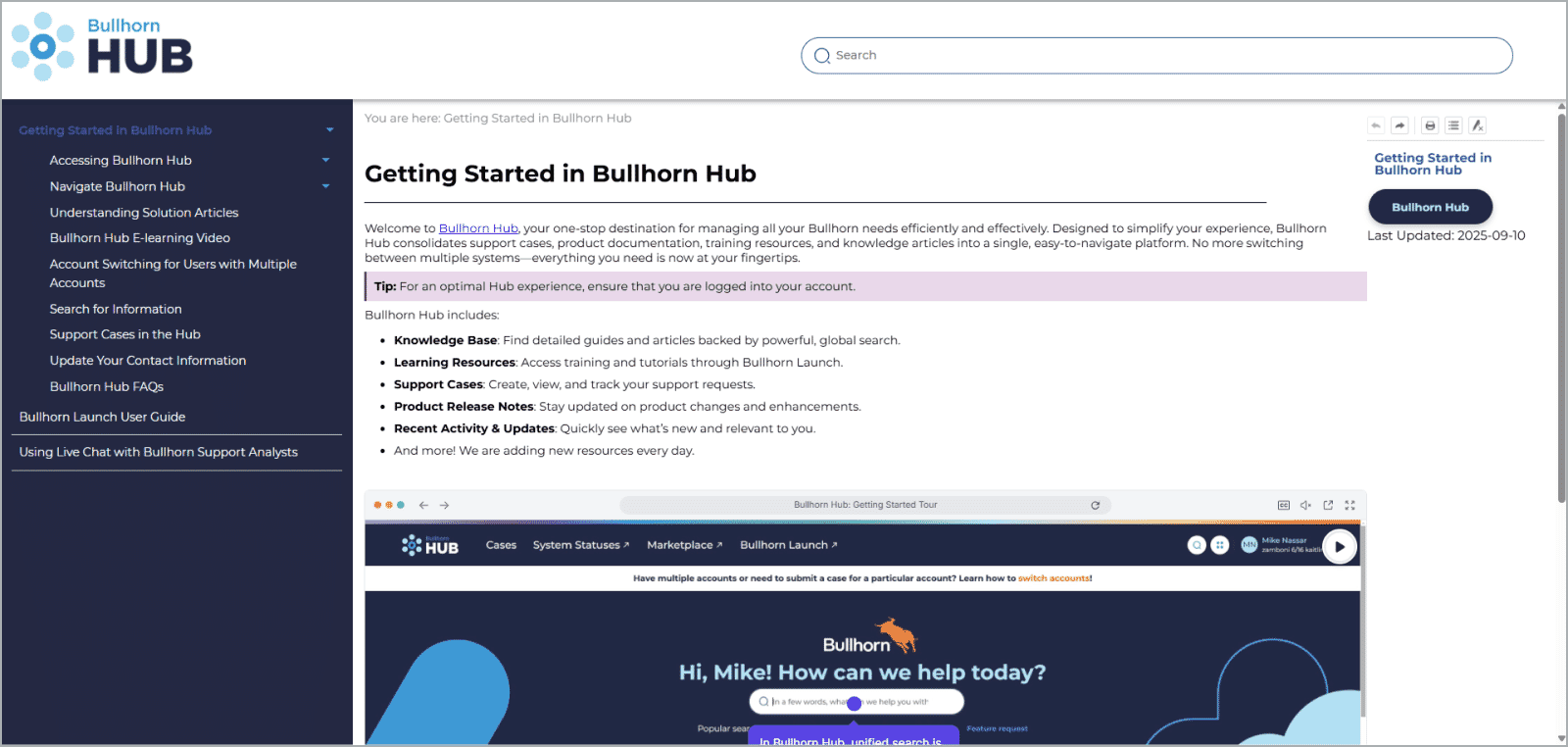
More recently, Bullhorn made a strategic decision to move from publishing knowledge base content in Salesforce to providing this documentation on a centralized, HTML5-based platform built on Salesforce Experience Cloud.
“As we were looking at our knowledge base development, we found that HTML5 was more flexible and provided a better experience for our customers,” noted Bethany Aguad, Bullhorn director of product documentation. “Now we exclusively use Flare Online to publish everything for product documentation to our Bullhorn Hub. It’s our single source of truth and ensures we can provide a consistent user experience.”
To ensure that the Bullhorn Hub in Salesforce Experience Cloud would provide a similar look and feel to the Salesforce experience, the documentation team used Flare to redesign all its knowledge base content.
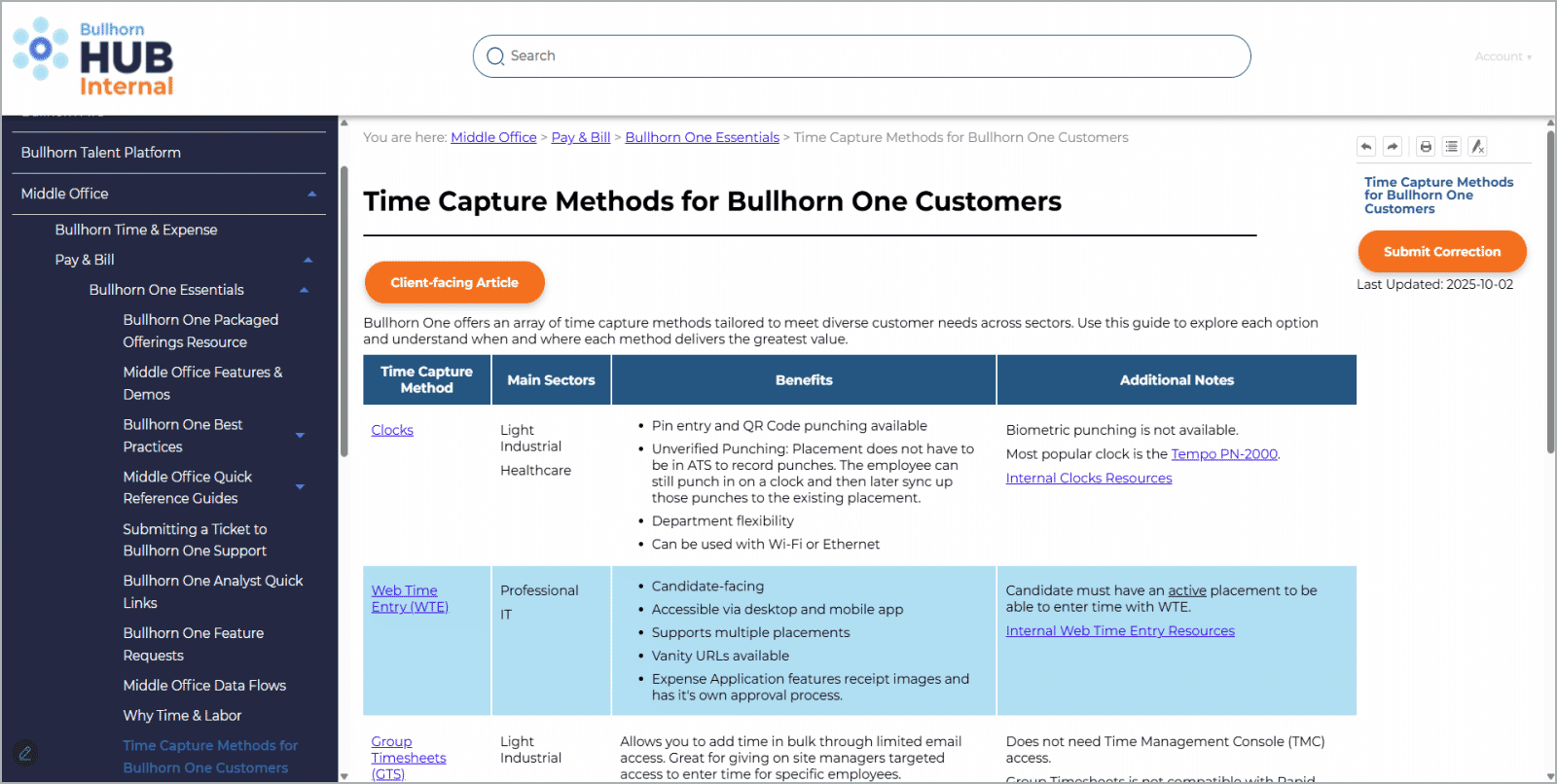
“We worked closely with our customer success manager at MadCap Software on style sheet changes, updating our targets, and more,” Bethany recalled. “He was a true partner in our redesign.”
Bullhorn also relied on the Extensible Markup Language (XML) support in Flare and automatic site map generation in Flare Online.
“The fact that Flare is based on XML and automatically adds content into the site map was super helpful in making sure our sites could be crawled and indexed properly to support users’ searches,” noted Erica Vahn, Bullhorn senior technical writer.
The Bullhorn Hub now serves both external and internal users, so the documentation team uses Flare Online to maintain two versions of its knowledge base content. Customers and prospects can access publicly available knowledge base documentation either through the Hub or via a Google search. Meanwhile, Flare Online enables Bullhorn to gate internal content and limit access to authorized users.
“We have a single sign-on process set up, so as soon as users try to access our internal knowledge base content, they get prompted to log in through our authentication provider to get provisioned a viewer seat in Flare Online,” Bethany explains.

When I joined Bullhorn, we had about 5,000 views per year across our documentation pages from Flare. In the last eight months, we’ve seen nearly 285,000 page visits, and that’s just external views. Our Flare-based content is becoming the go-to resource for most people.
Bethany Aguad Director, Product Documentation, Bullhorn, Inc.

Supporting Growth by Optimizing Team Efficiency
Maximizing team efficiency within the documentation team has become critical in supporting Bullhorn’s rapid growth. In addition to building new products, the company has also completed several acquisitions, and all the supporting knowledge base content needs to provide a consistent experience.
“We now have over 10,000 articles covering 20 products managed in Flare Online, and it's only going to grow,” Bethany says. “Not only do we need to create documentation for new product releases, but we also acquire content from other tools anytime Bullhorn acquires a company.”
The use of templates within Flare Online has helped to speed the creation of new documentation websites that link to the Bullhorn Hub. Once Bullhorn has the content organized in Flare, it takes the team about an hour to work with the logos, tune the table of contents, and then publish it with Flare Online.
“It’s been great to import that content into Flare Online and already have our templates, stylesheets, and branding set,” Bethany notes. “This way, we can publish the documentation to our Hub faster, make it searchable by our customers, and then continue to iterate and make improvements.”
The Bullhorn team leverages the parent and child process and global project linking in Flare to facilitate content reuse and ensure consistency.
“Bullhorn is a nimble organization, which means we regularly get new products, rebrands, adjustments to product names, and updated product logos. So, we maintain all our design assets in a global project in Flare,” Bethany explains. “Then, with global project linking, we can make an update once and have it cascaded to all relevant content published using Flare Online. That’s pretty crucial to us.”
Bullhorn has gained additional efficiencies since switching from Flare desktop software to the Flare Online cloud-based platform to publish its knowledge base documentation.
“I love Flare Online for its user interface and ease of use; we can publish content two to three times faster, especially when handling larger projects,” Erica notes.
Bethany adds, “Now with Flare Online, an author can publish instantly as soon as the content is complete. It really empowers our writers to own the full workflow for themselves. They're not dependent on someone else for content delivery.”
Enabling Collaboration and Analysis
Online collaboration among Bullhorn’s authors and subject matter experts (SMEs) has always been crucial to developing the company’s knowledge articles. Using Flare Online, the team has continued to streamline the process of contributing, reviewing and editing content in the cloud while taking advantage of the advanced authoring capabilities in on-premises instance of Flare.
The combination of the Flare on-premises version and Flare Online has also made it easier for Bullhorn to bring on contractors to create documentation for newly acquired product lines.
For example, when a company acquired by Bullhorn lacked product documentation, the team went out to the MadCap community and hired a contractor, who was able to work directly in Flare and Flare Online to produce the content in approximately three weeks.
Beyond collaboration, Bullhorn takes advantage of Flare Online to analyze content, as well as analyze end-users’ experiences.
“We’re very data-driven in our decision making, so we're using Flare Online analytics to understand what content is seeing high traffic and where we have gaps in our documentation,” Bethany observes. “We review the data month over month, and we have a process for our technical writers to review the feedback, determine actions, and move forward.”
Flare is the single source of truth for our knowledge base content, and since it is tagged and indexed, the Sophia AI agent can directly pull from this content to answer users’ questions. It is the backbone of our AI-driven support.
Erica Vahn Senior Technical Writer, Bullhorn, Inc.

Centralized Content Fuels AI-Driven Experiences
The user experience is an area where Bullhorn has invested extensively. The company’s customers need to be able to locate knowledge base information across many product lines easily, and that information needs to be both timely and consistent.
“One of the biggest benefits of Flare for Bullhorn is that everything lives in one place. Instead of piecing together docs across different tools, the team can build release notes, troubleshooting guides, and knowledge articles in Flare and then reuse them wherever they’re needed. That structure not only keeps everything consistent and scalable, it’s also what makes our documentation ready to power AI-driven support like the Agentforce chatbot,” Erica observes.
Recently, the documentation team has started using Flare Online to help fuel a new Bullhorn AI support agent named Sophia, which is built on Salesforce Agentforce technology and uses natural language processing to understand users’ requests.
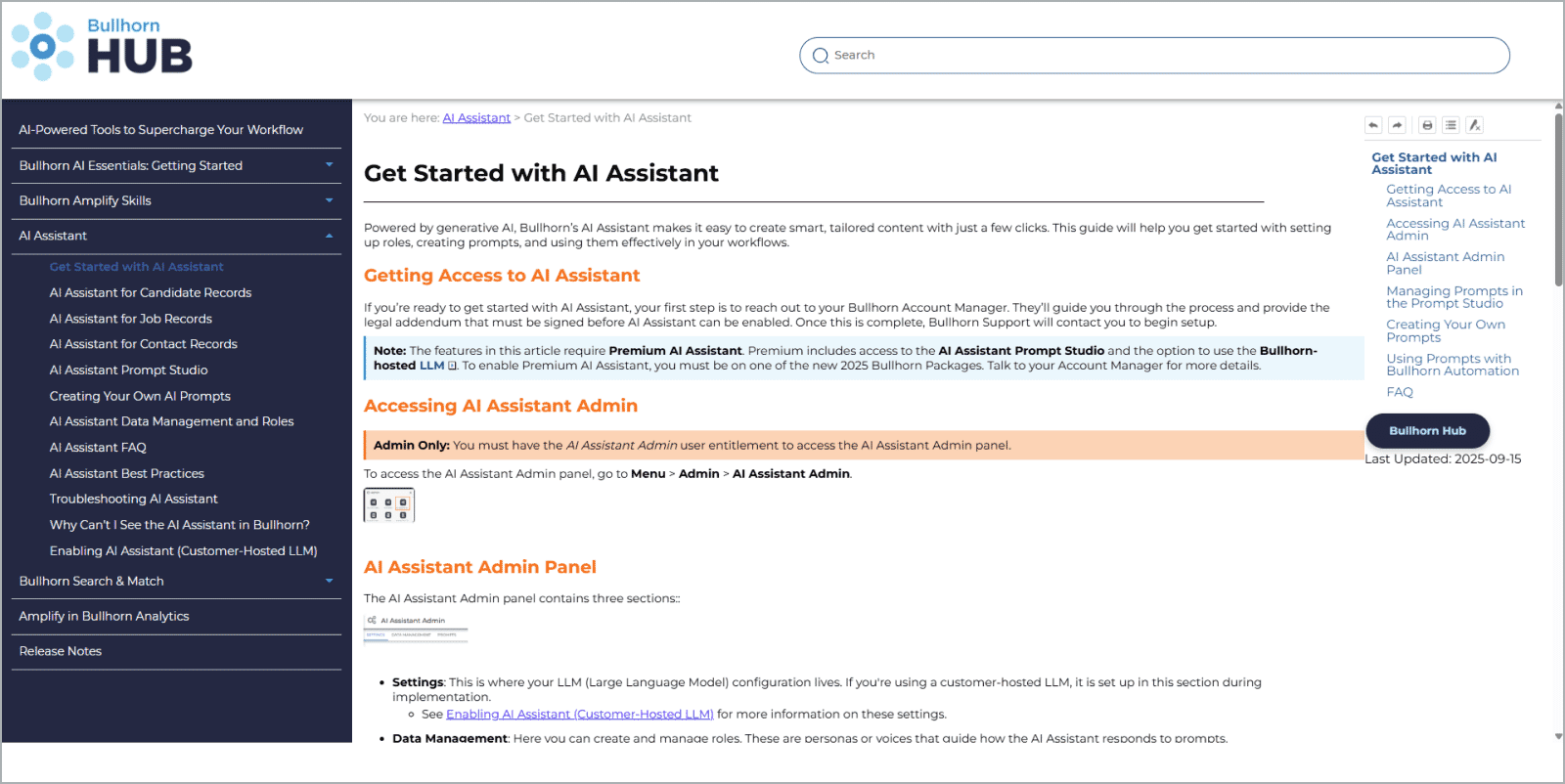
“Flare is the single source of truth for our knowledge base content, and since it is tagged and indexed, the Sophia AI agent can directly pull from this content to answer users’ questions,” Erica explains. “We’re also using Flare to structure documentation with snippets and sections that include natural language processing to help the AI agent make intelligent connections between users’ questions and available content. It is the backbone of our AI-driven support.”
At the same time, Bullhorn is taking advantage of the Sophia AI agent to gain additional insights into users’ content experiences.
“An exciting aspect of our content in Flare is that we can meta tag whatever we need to obtain more extensive customer experience data using AI,” Bethany observes. “It lets us be nimble in identifying and filling in gaps and optimizing our documentation—without having to wait on development from another team. We can just roll out the changes and see the results.”

I love Flare Online for its user interface and ease of use; we can publish content two to three times faster, especially when handling larger projects.
Erica Vahn Senior Technical Writer, Bullhorn, Inc.
Reducing Demands on Support
Because customers and employees, alike, can more readily find the information they need, Bullhorn has been able to reduce demands on the support team. Not only are there fewer customer support tickets; the company has seen first-call resolution and average handle times go down since users don't need to stay on calls as long.
“When I joined Bullhorn, we had about 5,000 views per year across our documentation pages from Flare. In the last eight months we’ve seen nearly 285,000 page visits, and that’s just external views,” Bethany noted. “We're also finding that about 21% of all customer searches take a single click for their results. Our Flare-based content is becoming the go-to resource for most people.”

 Tweet
Tweet
 Share
Share Share
Share